AI Classroom Operating System for Indian Schools
Alan Scott LearniX delivers an institutional educational technology suite connecting multilingual AI teaching assistance, virtual science simulation laboratories, and NEP 2020 competency evaluation across K-12 institutions.
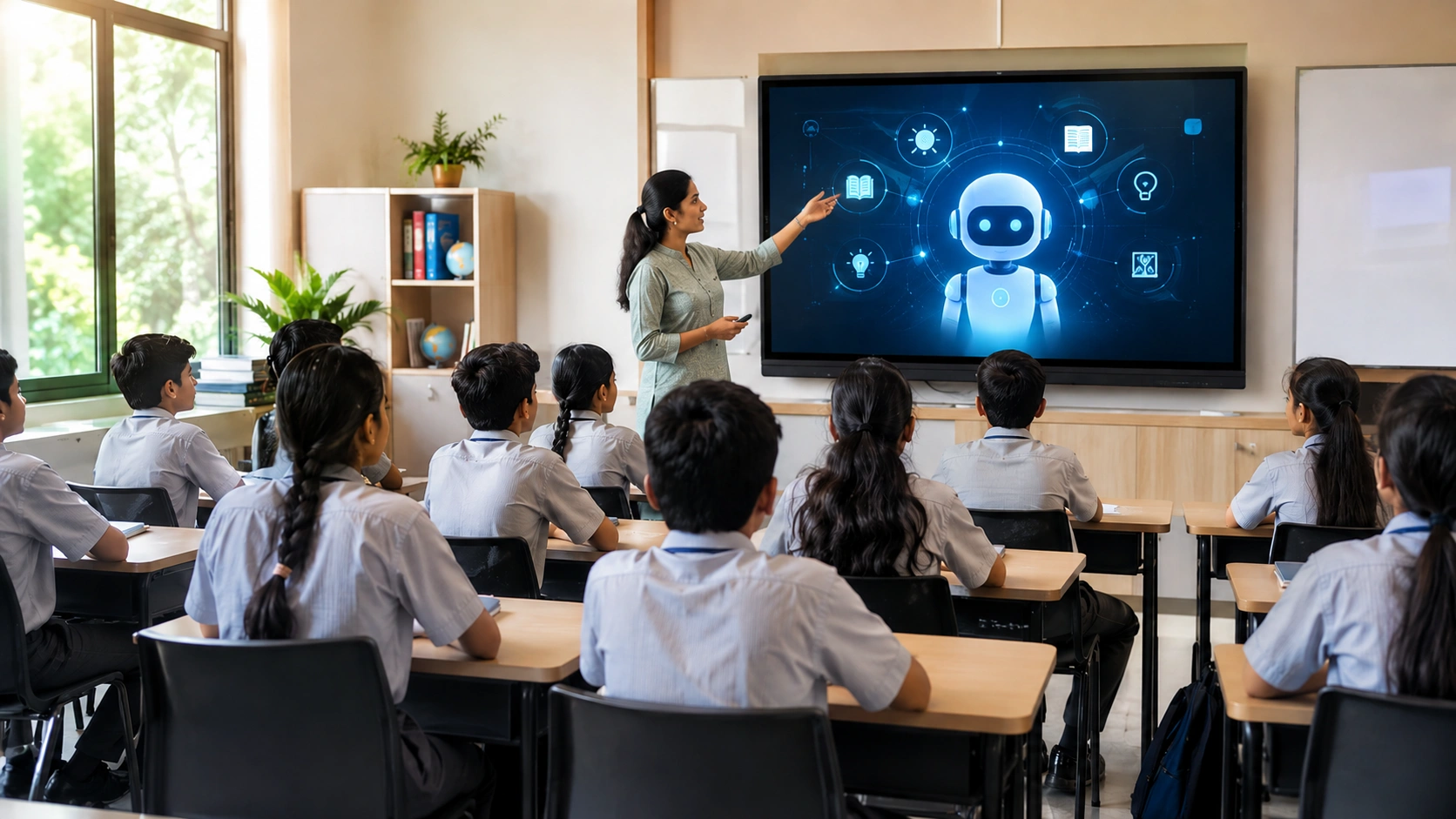
The Practical Realities of Indian School Classrooms
Institutional education requires tools that function within existing operational boundaries. Technology must reinforce educator mentorship rather than demanding impossible infrastructure upgrades.
Individual Attention
With standard classroom sizes of 40 to 60 students, teachers cannot address every nuanced doubt during a 45-minute period.
Practical Lab Access
Physical science experiments are often limited by schedule constraints, recurring chemical costs, and safety precautions.
Language Barriers
Conceptual clarity often breaks down when students transition from regional medium schooling to complex English technical terms.
Infrastructure Variations
Classrooms across tier-2, tier-3 cities and rural zones encounter variable connectivity and require resilient computing solutions.

A Connected Institutional Architecture
Rather than disconnected point tools, LearniX unifies teacher guidance, hands-on scientific practice, and holistic cognitive mapping into one framework.
Teaching Companion and Multilingual Doubt Resolution
KrishGuru functions as an institutional teaching co-pilot. In class, it helps educators generate practice sets and contextual analogies. After school hours, students consult it for step-by-step problem-solving in English, Hindi, and regional languages.
Explore KrishGuru In Detail →

Curriculum-Mapped Virtual Science Simulations
SudarShan AI provides interactive digital experiment setups for Physics, Chemistry, and Biology. Students manipulate electrical voltages, titration reagents, and optical lenses directly on computer screens without resource constraints.
Explore SudarShan Virtual Labs →

Competency and Multi-Intelligence Evaluation
Dishant Patra evaluates learners beyond rote memorisation. By analyzing problem-solving pathways, cognitive persistence, and conceptual synthesis, it produces developmental profiles aligned with NEP 2020 guidelines.
Explore Dishant Patra Framework →
KrishGuru AI: Dedicated Educator and Student Co-Pilot
Engineered specifically for Indian K-12 academic syllabi, KrishGuru resolves conceptual doubts step-by-step without simply handing over unearned answers.
-
Classroom Support for Teachers: Instantly draft lesson summaries, chapter quizzes, and tiered remedial exercises for diverse learning speeds.
-
Multilingual Concept Clarity: Explains complex scientific principles in natural conversational Hindi, English, and regional languages.
-
Curriculum Alignment: Strictly referenced against NCERT textbooks, CBSE, ICSE, and Indian State Board standards.
Student Query: “Why does current remain constant in a series circuit but voltage divides?”
KrishGuru Explanation: “Think of electric charge like water moving through a single closed pipe. Because there is only one pathway, the flow rate (current) cannot disappear or branch off. However, pushing that charge across consecutive resistors requires electrical work, meaning potential difference (voltage) drops across each component.”
SudarShan AI Labs: 15 Virtual Science Domains
Practical experiential learning across secondary school science. Students manipulate variables, test scientific hypotheses, and record observations safely.
Dishant Patra: Multi-Intelligence Competency Evaluation
A student’s future cannot be predicted by a single exam number. Dishant Patra provides qualitative behavioral and cognitive insight aligned with the National Education Policy 2020.
-
Cognitive Processing Patterns: Evaluates logical deduction, pattern recognition, and conceptual linkage during live problem solving.
-
Persistence and Resilience Metrics: Observes whether a student adjusts variables after an incorrect attempt or abandons the exercise.
-
Academic Mentoring Summaries: Generates clear, compassionate diagnostic observations for teachers and parents during parent-educator conferences.
Broader Institutional Innovations
Alan Scott LearniX extends specialized solutions addressing literacy, vocational capability, and operational enablement across institutional communities.

BoloBook
An interactive voice-enabled literacy and reading assessment platform designed to strengthen phonetic fluency and reading confidence in early grades.
Request Product Brief →
PaisaPal
Practical financial literacy and budget simulation platform introducing high school learners to real-world banking, taxation, and savings fundamentals.
Request Product Brief →
MSME Solutions
Vocational enablement tools designed for polytechnics, industrial training institutes, and vocational centers to develop enterprise skills.
Request Product Brief →
NextGen
Advanced digital literacy and foundational computing curriculum modules designed for progressive school computer labs.
Request Product Brief →
Techno Class
Smart classroom presentation architecture supporting multi-screen projection, teacher tablet synchronization, and local resource sharing.
Request Product Brief →
Institutional Computing Hardware: LearniX Laptop
Built to provide dependable local computation for Indian classrooms, computer centers, and mobile educator kits without fragile operating overhead.
Classroom Computing
Calibrated for high daily student utilization in school lab environments.
Pre-Installed Software
Equipped with LearniX offline simulation modules and local tutor packages.
Institutional Deployment
Available through bulk institutional procurement and CSR foundation grants.
Comprehensive Support
Backed by official enterprise warranty and hardware replacement agreements.

The Five-Stage Classroom Instructional Workflow
How educators and students interact with LearniX across a standard academic lesson cycle.
Stage 1: Lesson Preparation and Setup
Prior to class, the teacher uses KrishGuru to extract key curriculum analogies, common textbook misconceptions, and differentiated practice problems mapped to that day’s chapter.
Key Deliverable: Customized 45-minute lesson roadmap and interactive experiment selection.
- ✓ Select NCERT chapter module
- ✓ Verify simulation parameters in SudarShan
- ✓ Export bilingual explanation summary
Stage 2: Classroom Conceptual Explanation
The educator introduces theoretical concepts on the smart board, projecting live interactive visualizations to ground abstract mathematics or scientific laws in tangible visuals.
Key Deliverable: High whole-class visual engagement and active discussion.
Students observe dynamic variable adjustments in real time, raising hypotheses about what happens when values double or reverse.
Stage 3: Hands-On Virtual Exploration
Students move to school computers or personal tablets to run the SudarShan experiment individually or in pairs, adjusting circuit switches and titration volumes directly.
Key Deliverable: Experiential trial-and-error without equipment breakage.
Learners test edge cases safely: overloading simulated voltages or checking organic compound solubilities repeatedly.
Stage 4: Formative In-Flight Assessment
Dishant Patra logs the decision pathways of each learner during the experiment, identifying whether confusion stems from mathematical computation or scientific principles.
Key Deliverable: Immediate diagnostic signals without grading paperwork.
Automated synthesis highlights which specific students require follow-up scaffolding on circuit formulas.
Stage 5: Review and Remedial Closing
The lesson concludes with targeted closing questions. KrishGuru provides personalized homework practice sets matching each student’s identified challenge areas.
Key Deliverable: Closed learning loops and clear home study direction.
Teachers receive an aggregate class mastery card; students receive 3 focused practice challenges to solve at home.
Architected for Diverse Institutional Partners
LearniX adapts to the operational mandates of private school chains, state education missions, and philanthropic organizations.
Private K-12 Schools and Colleges
Enhance academic outcomes and institutional reputation with advanced STEM simulation labs and modern AI teaching aids that require no expensive physical infrastructure overhaul.
Government & State Education Missions
Large-scale regional deployments supporting district smart school initiatives with robust offline capability, state board alignment, and Indian language instruction.
CSR Foundations and NGOs
Direct impact educational technology programs delivering measurable learning improvements, verifiable usage telemetry, and zero recurrent consumable costs in underserved schools.
Connectivity and System Accessibility Architecture
Clear technical specifications regarding network requirements, device compatibility, and offline functional boundaries.
| Functional Layer | Offline Execution | Low-Bandwidth Mode | Network Sync Requirement |
|---|---|---|---|
| SudarShan Virtual Simulation Labs | Fully functional offline when local packages are cached. | Smooth simulation performance via lightweight WebAssembly. | Required only for periodic syllabus updates and telemetry sync. |
| KrishGuru AI Doubt Clearing | Core formula and textbook database accessible locally. | Text prompts optimized for 2G / 3G mobile data connections. | Cloud query expansion requires occasional internet ping. |
| Dishant Patra Assessment | Test sessions run locally without connection drop risk. | Assessment payloads compress to under 50KB per classroom. | Syncs batch assessment records when network restores. |
| Supported Operating Hardware | Windows 10/11 PCs, standard Chrome/Edge web browsers, Android tablets, and dedicated LearniX computing hardware. | ||
Alignment with National Educational Priorities
Designed to support key directives of the National Education Policy 2020 and NCERT curricular learning goals.
Experiential Learning Focus
Transforms theoretical textbook chapters into hands-on virtual inquiry. SudarShan simulation labs directly fulfill NEP 2020 recommendations for practical STEM experience in every secondary school.
Competency-Based Evaluation
Shifts the institutional focus from memorized percentage marks to demonstrable cognitive competencies, logical deductions, and applied problem-solving abilities.
Teacher-Centric Design
Honors the central role of the educator. LearniX acts as an instructional amplifier that reduces administrative routine, empowering teachers to mentor with greater personal focus.
Institutional Value by Stakeholder Role
Discover how the LearniX operating ecosystem serves specific daily classroom priorities.
Lesson Planning Acceleration
Generate curriculum-aligned practice sets, illustrative examples, and conceptual quizzes in minutes instead of spending hours on routine preparation.
Classroom Demonstration Control
Project interactive physics, chemistry, and biology setups on screen to clarify abstract formulas before students encounter them in homework.
Diagnostic Student Visibility
Identify which students struggle with specific syllabus concepts through automated competency records, without adding to your grading paperwork.
Unlimited Experiment Practice
Perform science experiments repeatedly, test what happens when variables change, and learn safely without fear of breaking laboratory equipment.
24/7 Step-by-Step Doubt Resolution
Consult KrishGuru AI whenever you get stuck on a textbook problem or difficult formula, receiving clear explanations in simple language.
Multilingual Conceptual Clarity
Review difficult scientific and mathematical terminology in Hindi, English, or regional languages to ensure deep subject comprehension.
Institutional Differentiation
Position your institution at the forefront of modern STEM education with comprehensive virtual simulation labs that satisfy NEP 2020 mandates.
Zero Physical Lab Overheads
Eliminate recurrent expenses for fragile glassware, expensive chemical consumables, and specialized physical laboratory maintenance.
Verifiable Academic Progress
Access objective, aggregate competency data across classes and subjects to support curriculum planning and demonstrate progress to parents.
Structured Institutional Evaluation Process
How schools and institutional partners evaluate, pilot, and deploy the LearniX classroom ecosystem.
1. Institutional Consultation
Our academic specialists meet with your leadership and department heads to review existing computer lab infrastructure, board affiliations, and pedagogical objectives.
2. Scoped Classroom Pilot
Deploy LearniX in a selected grade cohort (typically Class 9 or 10) to observe student engagement with SudarShan labs and teacher workflow integration.
3. Educator Preparation
Structured hands-on orientation sessions for science and mathematics teachers, demonstrating classroom projection techniques and assessment analytics review.
4. Evidence Review
Synthesize teacher feedback, student simulation completion rates, and doubt resolution patterns to determine institutional fit before broader rollout.
5. Phased Campus Rollout
Gradual expansion across secondary grades, configuring offline local caches and establishing regular academic support checkpoints.
6. Ongoing Academic Support
Dedicated institutional support desk, regular curriculum database updates, and periodic educator workshops to maximize academic value.
Perspectives from Partner Classrooms
Authentic reflections from educators who integrate LearniX virtual simulation labs and teaching assistance into daily lessons.
“Before using SudarShan, our Class 9 students could only perform physics experiments once a term due to lab scheduling. Now, students test ray optics and circuit resistance on screen before they ever touch physical apparatus.”
“What helps our teachers most is KrishGuru’s ability to explain scientific terms in simple Hindi when students struggle with English textbooks. It bridges the language gap in mixed-medium classrooms.”
“Dishant Patra’s competency summaries gave us an objective basis for parent-teacher conferences. Parents could see where their child was conceptually strong rather than just looking at a single exam score.”
What Your Institution Can Evaluate During a Pilot
Six concrete, measurable dimensions school leaders can observe during a structured four-week campus evaluation.
1. Teacher Adoption Velocity
Measure how quickly science and math educators incorporate interactive simulation modules into their regular lesson plans and classroom explanations.
2. Student Voluntary Practice
Track how often learners use the virtual labs independently to re-run experiments and explore different parameter combinations outside class hours.
3. Doubt Resolution Patterns
Observe the specific curriculum topics where students seek step-by-step guidance from KrishGuru, revealing subject-level conceptual friction points.
4. Infrastructure Resilience
Validate system stability across your campus computer lab network, including offline performance during periods of intermittent internet connectivity.
5. Teacher Feedback Quality
Collect structured educator assessments on whether the platform reduced administrative workload and enhanced classroom engagement.
6. Parental Engagement
Evaluate parent response to Dishant Patra’s competency summaries during parent-educator discussions compared to traditional mark cards.
About Alan Scott LearniX Limited
Alan Scott LearniX Limited is an indigenous educational technology company dedicated to developing purpose-built classroom software and computing solutions for Indian schools.
Teacher-Support Philosophy
We believe technology must support, not replace, the classroom teacher. Our tools are built to handle routine explanations and administrative tracking, freeing educators to focus on human mentorship.
Classroom-First Engineering
Every platform is designed around the real constraints of Indian institutions: varying class sizes, diverse linguistic backgrounds, standard computer hardware, and intermittent connectivity.
Institutional Accountability
As an institutional partner, we provide clear service-level commitments, dedicated on-campus orientation, and transparent technical architecture tailored to institutional governance.
Corporate Details
Registered Name: Alan Scott LearniX Limited
Corporate Focus: AI Classroom Operating Systems, Virtual Science Laboratories & Educational Computing Hardware
Headquarters: 302, Viva Icon, Hinjewadi Wakad Road, Pune 411057, Maharashtra, India
Official Helpline: +91 81080 23838
Official educational technology partner for schools, colleges, state educational initiatives, and CSR education programs across India.
Educational Briefs and Technical Documentation
Institutional reference materials explaining platform capabilities, curriculum mappings, and implementation guidelines.
SudarShan Science Lab Catalogue
Comprehensive curriculum mapping of all 15 virtual simulation lab domains across Physics, Chemistry, and Biology for Classes 6 to 12.
NEP 2020 Implementation Guide
An institutional guide for school principals on meeting NEP 2020 experiential learning and competency evaluation directives using digital tools.
Campus Pilot Evaluation Framework
A structured four-week rubric for school academic committees to assess educator adoption, student engagement, and infrastructure readiness.
Frequently Asked Questions
Clear answers to common institutional, pedagogical, and technical questions about LearniX.
Schedule an Institutional Consultation
Connect with our academic team to discuss your school’s curriculum requirements, computer lab readiness, or evaluation pilot scope.
Direct Institutional Helpline
Speak directly with our academic partnerships team:
+91 81080 23838
Corporate Headquarters
Alan Scott LearniX Limited
302, Viva Icon, Hinjewadi Wakad Road, Pune 411057, Maharashtra, India
Official Web Portal
Visit: aslearnix.ai
Institutional Enquiry
Please complete the details below to request a tailored institutional walkthrough.